Everybody and their momma has a hip-hop blog now. Substack, Medium, a self-hosted site they update twice a year, and the supply is endless, and most of it is reposted press releases with hot takes slapped on top. If you actually want to know how to start a hip-hop blog that earns bookmarks instead of bounce rates, the bar is higher than it used to be. You need a mission, a voice, and the kind of editorial discipline that survives the second month.
Key Takeaways
- Mission First: A clear vision and a one-line content promise shape every post and the audience you attract.
- System Beats Inspiration: A repeatable brief, outline, draft, edit, publish loop holds the line when motivation doesn’t show up.
- Hip-Hop as Scholarship: Treat lyrics as primary sources and album sequencing as editorial. The depth shows in the writing.
- Distribution You Own: Build the email list from day one. Social platforms can change the algorithm tomorrow.
- Govern the Archive: Quarterly audits and visible updates separate a publication from a graveyard of stale posts.
Start your hip-hop blog with a clear mission
Passion is not a content strategy. You can love hip-hop more than the group chat does and still produce posts that read more like Wikipedia footnotes than compelling commentary. The first move when figuring out how to start a hip-hop blog is brutal honesty about who it’s for.
Are you writing for casual fans who want context on why Kendrick’s catalog hits a different way? Critics and academics who want rigorous analysis? A community of commentators who already live in the comments? Each of those audiences expects a different tone, a different cadence, and a different roster of artists. Pick one, and the rest of the work gets easier.
Pick a Lane and Stay in It
- Reviews and Album Breakdowns: track-by-track close reads, scoring frameworks, sequencing analysis.
- Cultural Commentary: politics, identity, language, and the conversation that wraps around the music.
- News and Industry Coverage: labels, deals, business, and the parts the EPK doesn’t mention.
- Regional Scene Reporting: Detroit, Atlanta, Houston, the Bay, wherever the local sound is moving faster than the national press can track.
- Artist Profiles and Interviews: long-form, on the record, the kind of work nobody has time to do anymore.
You can mix lanes, but pick a primary. Blogs that try to do everything tend to do nothing well. Once the audience and the lane are locked in, write a one-line content promise that tells readers what they get every time. Something like, “We cover hip-hop as culture, not just music.” That single sentence sets your tone, your scope, and your expectations in one move.
Language is part of the beat too. Knowing the evolution of hip-hop slang isn’t trivia. It’s how you write with authenticity instead of performing it.
Pro Tip:
Build a repeatable content brief that answers three questions before you write a word. Who is this for? What do they learn? Why does it matter right now? Reusable briefs kill the blank-page panic.
Build an editorial workflow that survives the second month
Mission set. Now the unsexy part. Most blogs collapse here. Writers wait for inspiration, publish randomly, and then act surprised when the analytics look like a flatline on a hospital monitor.

The five-step editorial loop
A working editorial workflow follows the same five steps every time: brief, outline, draft, edit, publish. The brief defines purpose. The outline structures the argument. The draft gets it on the page. The edit tightens it. Then it ships. Skipping a step is what makes blogs look amateur, even when the writing is fine.
Where most blogs cut corners versus what an actual workflow looks like:
- Ideation: Random ideas, vs. a topic calendar built around your mission pillars.
- Briefing: No brief, vs. a documented brief that fits on one page.
- Drafting: Write and ship, vs. write, peer review, revise.
- Editing: Quick read-through, vs. a structured edit checklist.
- Publishing: Whenever, vs. a fixed cadence on the same days every week.
- Performance Review: Never, vs. a weekly analytics check with notes.
The actual production loop, step by step:
- Build a monthly topic calendar grouped by your mission pillars.
- Write a one-page brief for every post before drafting.
- Outline before writing a single sentence.
- Draft with voice and specificity, not just information.
- Edit for clarity, tone, and factual accuracy, in that order.
- Publish on a fixed schedule, the same days every week.
- Review performance after 72 hours and feed it back into the calendar.
Pro Tip:
Document the workflow in a shared Notion page or Google Doc on day one. When you eventually bring on contributors, they’ll match your standards without a forty-minute Zoom call. A solid workspace setup doesn’t hurt either. It’s the difference between writing as grind and writing as craft.
Templates and Checklists
Templates and pre-publish checklists are the backstop. Build a post template with sections for hook, cultural context, analysis, and takeaway. Use a checklist that asks: Is the claim sourced? Is the voice consistent? Did this post actually deliver on the content promise? Boring tools, but they’re what separates a blog that grows from a blog that dies.
Treat Hip-Hop as Scholarship, Not Entertainment
Systems handled.
Now the actual writing. This is where you separate yourself from the recycled-press-release crowd.
If you’re covering the genre as cultural commentary, treat hip-hop texts as legitimate knowledge, not just entertainment. Lyrics are primary sources. Music videos are visual arguments. Album sequencing is editorial decision-making. The moment you start writing about it that way, the work gains a credibility ceiling that gossip blogs simply can’t fu**ing reach.
Sources worth citing, in roughly the order you should reach for them:
- Official Artist Channels: Verified socials and artist sites for primary-source accuracy.
- Official Uploads: VEVO, Spotify artist pages, and Genius for confirmed lyrics and metadata.
- PRO Databases: ASCAP and BMI for songwriting credits and publishing splits.
- Academic Texts: Journal articles and cultural studies books for analytical frameworks.
- Reputable Music Press: Pitchfork, The Source, Rolling Stone, and HipHopDX for industry context.
Four analytical frames that will lift any post:
- Scene Analysis: What is happening in this song, video, or moment, on the surface?
- Cultural Context: What was happening in the world when it was made?
- Discourse Analysis: What is the artist saying about power, identity, or community?
Hip Hop is not a physical thing, it is a metaphysical principle. It is an energy, a consciousness, it is an awareness, it is a behavior, it is an attitude… The attitude, the behavior, the collective consciousness produces rap, break dancing, graffiti art, DJ-ing and everything else that comes out of the culture
KRS-One
Global context belongs in the toolkit too. Look at K-pop’s borrowing from hip-hop as a case study in cultural export. Track how hip-hop’s visual art moved from the streets to galleries. Don’t sleep on regional differences as a lens for how geography shapes sound and identity. These aren’t just related reading. They’re frameworks for your own analysis.
Write with Hip-Hop’s Structural DNA
Knowing what to analyze is one half of the job. Writing it so somebody actually finishes the post is the other half. The good news is that the genre itself hands you the blueprint.
A great rap verse runs on three moves. There’s a setup that establishes the scene and the stakes. There’s tension that builds through conflict, contradiction, or revelation. Then there’s a resolution that lands the point. Reviews and essays should follow the same arc.
Hip-hop craft frameworks emphasize specificity, scene-setting, tension, and resolution, the same principles that make written analysis work. A review that opens with a specific moment from the recording context, builds tension through a lyrical contradiction, and resolves with a clear cultural argument will always outread a five-paragraph summary of what the album sounds like.
How to write hip-hop-informed analysis, in order:
- Open with a specific scene, lyric, or moment that anchors the reader on sentence one.
- Layer in cultural and biographical context that explains why the moment matters.
- Identify the central tension or argument inside the work.
- Support the read with specific lyrical, sonic, or visual evidence.
- Connect the work to broader cultural conversations or historical patterns.
- Close with a takeaway only your voice could deliver.
Pro Tip:
Read every draft out loud before you ship it. Hip-hop is an oral tradition. If your sentences sound flat when spoken, they read flat on the page. The best commentary in this space has cadence, not just information.
For a case study in setup, tension, and resolution at album scale, look at how J. Cole’s apology set sequenced its argument. That’s the level of intentionality the writing should aim for.
Grow Your Audience and Measure What Actually Matters
You can write the sharpest hip-hop commentary on the internet, and if nobody distributes it, nobody reads it. Social media alone isn’t a strategy. It’s a rented platform that can change its algorithm tomorrow and leave you holding a follower count that doesn’t click anything.
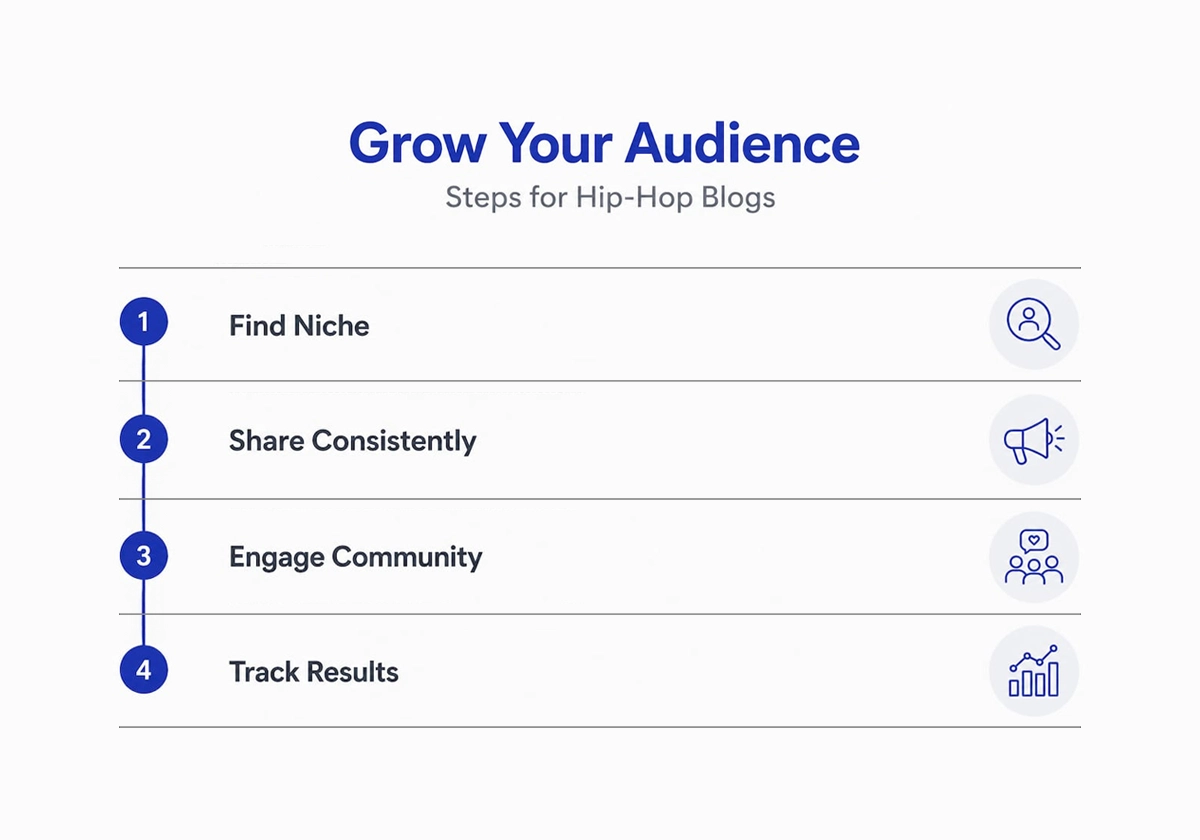
From day one, build the email list and ship two to three posts per week. Email is the one channel you actually own. Subscribers chose to hear from you, which makes that relationship worth more than ten thousand passive social followers who never click a link.
What an actual audience growth stack looks like:
- Email List: A signup form with a real lead magnet (a free guide to ten essential albums, a curated playlist, anything actually useful).
- Consistent Cadence: Two to three posts per week, the same days, every week.
- Cross-Posting: Excerpts on X, Instagram, and TikTok that send traffic back to your site, not the other way around.
- Community Engagement: Comment on other blogs and forums as yourself, not as a promo account anyone can spot.
- Collaborations: Guest posts and joint interviews with other writers or artists expand reach faster than any ad.
Pro Tip: Track every post after it ships. Which topics earned the most clicks? Which headlines drove the most opens? Use that data to refine the calendar, not to chase trends. The point is to learn what your specific audience wants, not to copy what worked for somebody else.
Tools worth using: Google Analytics for traffic, Mailchimp or Kit (formerly ConvertKit) for email, and a single spreadsheet to track post performance over time. AI’s impact on hip-hop media is also worth tracking, because the tooling around blogging is changing fast and the goal is to use it without losing your voice.
Govern your Archive Like a Real Publication
Most bloggers treat their archives like a graveyard. Publish, move on, never look back. That’s a credibility leak. Hip-hop moves quickly, and an article from two years ago that still references a defunct label or a pre-controversy artist reflects on the entire platform.
Content governance sounds corporate. It’s actually just responsible journalism with a different name. Write it down once, then use it every quarter.
What a working governance plan covers:
- Quarterly content audits: Review every post older than six months for accuracy and relevance.
- Update process: When an artist’s situation changes, update the relevant posts and timestamp the change visibly.
- Archiving policy: Posts that are no longer relevant get redirected to updated coverage or pulled from public indexing.
- Repurposing strategy: Top-performing posts become newsletter editions, video scripts, or social threads.
- Fact-check schedule: Verify external links and citations every six months, no exceptions.
Pro Tip:
Let analytics decide what gets updated first. A post still pulling traffic with outdated information is the highest-priority fix. A post pulling zero traffic on a topic that no longer matters gets archived. Credibility comes from future-proofing the catalog as the culture moves.
The uncomfortable truth about hip-hop blog authority
Most hip-hop blogs stay stuck at beginner level not because the writers lack talent. They lack editorial discipline. They chase the viral moment, write about whatever is trending on X this hour, post three times in a week, and then disappear for a month. Readers notice.
Authority in this space comes from three things. Consistency. Originality. Transparent sourcing. Show up on schedule, say something nobody else is saying, back it with receipts. That’s the formula, and it’s harder to execute than it reads.
About the shortcuts. A lot of new bloggers rush to submit to promotion sites before they’ve developed an editorial voice. That’s the move in the wrong order. Submission sites and playlist placements are amplifiers. They amplify whatever is already there. Thin content gets ignored faster, just at scale.
If you’re serious about how to start a hip-hop blog that earns trust, build the editorial foundation before chasing reach. Twenty posts with a real voice. A publishing rhythm you can hold for a year. A point of view sharp enough that a reader could pick your byline out of a lineup with the name stripped off. Once that foundation is in place, every promotion tactic (submission sites, playlist placements, cross-posting) compounds instead of just adding noise to the pile.
The genre rewards the same instincts the writing does. Specificity over slogans. Discipline over hype. A voice that earned the room instead of borrowing it. Build the blog the way the artists you cover built their best records. Do it with intention, with patience, and with the assumption that readers can tell the difference between somebody doing the work and somebody performing it. They always can.
Shi* You Ask About A Lot
A content management system like WordPress, an editorial workflow tool like Notion or Trello, an email platform like Mailchimp or Kit, and analytics to iterate the calendar based on real performance data. That’s the minimum kit. Everything else is optional.
Aim for two to three posts per week, especially in the first six months. Consistent posting builds reader trust and signals to search engines that the site is active. Quality still beats volume, so don’t ship slop just to hit the cadence.
Borrow from hip-hop’s own structure: setup, tension, resolution. Treat lyrics, videos, and album sequencing as primary sources. Cite verifiable references, and write with a real voice. Most reviews are recycled press releases, so a little specificity goes a long way.
Editorial first. Submission and playlist placements are amplifiers, not foundations. They amplify whatever is already there, which is great if the work is sharp and ugly if it isn’t. Build twenty posts of real range and a clear voice before worrying about outreach.
Run a content governance plan. Quarterly audits, an update process for outdated posts, an archiving policy for content that no longer serves anyone, and a fact-check pass on links and citations every six months. Treat the archive like a publication, not a graveyard.