There’s a version of American pop culture that pretends gang affiliations are a side story, something that happens in a documentary, in a court transcript, in a song everyone listens to but no one credits. The truth is harder to ignore once you start tracing the lines. The colors on the hat in your closet, the cadence of the rapper on your “best of all time” list, the celebrity whose persona you absorbed without thinking about where the persona came from: all of it carries a fingerprint from somewhere most pop culture writing politely refuses to look. Gang influence on pop culture is not subtle. It’s just rarely named.

This article is part of our complete guide to How Hip-Hop Changed Everything.
This isn’t a piece about the dangers of gang life. There are enough of those. This is about credit. About influence. About the unpaid creative labor that a few square miles of LA and Chicago did for hip-hop, for sports streetwear, for Hollywood, and for the version of cool that everyone now imports as a default. You don’t have to glorify any of it to acknowledge it.
We’ve already documented the 10 most gang-affiliated hats in sports and the celebrities with notorious gang affiliations. Those are the receipts. This is the connective tissue, how a corner of post-industrial America ended up writing the rules for a global culture industry that still won’t say their names.

The Color Code That Wrote the Streetwear Playbook
Before Off-White or Supreme, before the Dodger blue cap became a Vogue photoshoot prop, there was an unwritten set of design instructions handed down by people who couldn’t afford luxury branding and didn’t need it.
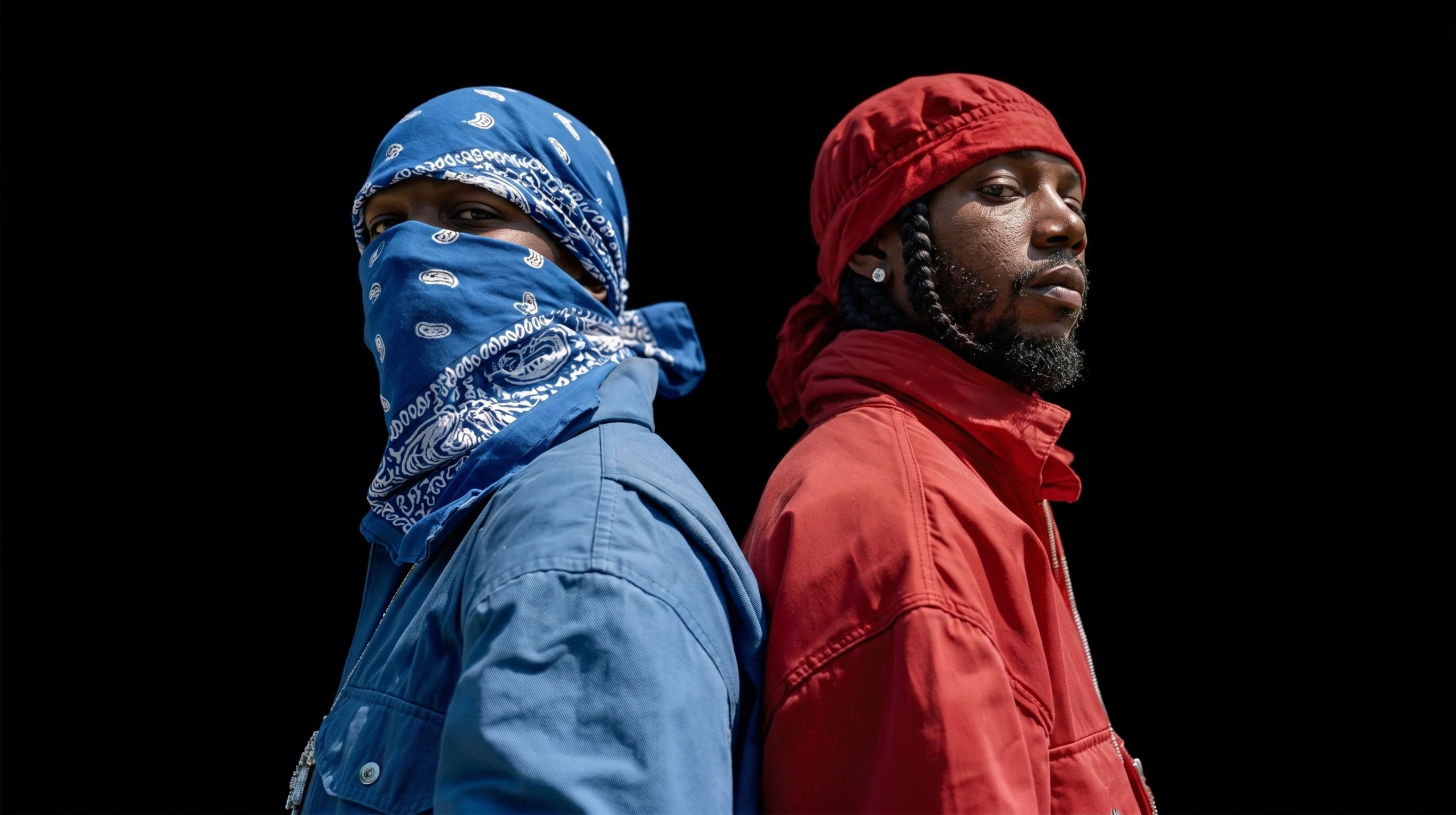
The Crips wore blue. The Bloods wore red. The Sureños took the Dodger blue. The Latin Kings took the Pirates’ black and gold. None of these were marketing decisions made in a conference room. They were practical choices. You needed a color that was already in the wild, already mass-produced, already easy to find at any swap meet. A team hat did the work for free. The corporate trademark became the gang signal almost by accident.
What’s wild is what happened next. The same hats that signaled membership to people who knew started signaling something else to people who didn’t. Danger as aesthetic. Authenticity as commodity. By the time the early ’90s arrived, the streetwear industry was running a quiet arbitrage: take the look that originated in a context most consumers would never enter, scrub it of its specifics, sell it back to suburban kids who wanted the rep without the bill.
If you want the breakdown of which hats carry which affiliations, our piece on the 10 most gang-affiliated hats in sports handles the specifics. What matters here is the principle: an enormous chunk of what we now call “streetwear” was sourced, without credit, from neighborhoods that mainstream fashion still doesn’t make eye contact with.
The Hollywood Pipeline Was a One-Way Door
There’s an enduring story Hollywood tells about itself: that talent rises, that authenticity wins, that the gritty rapper who plays himself in the indie crime drama is “discovered.” The story is wrong in a useful way. The pipeline from gang-affiliated rapper to Hollywood actor isn’t a discovery. It’s a transaction. Hollywood needed the imprimatur of the street; the rapper needed the legitimacy of the screen. Both sides knew what they were trading.
Ice-T didn’t just play a cop on Law & Order; he traveled from one of the West Coast’s most aggressive rap careers to twenty-plus seasons of network procedural without any of the corporate apology that usually accompanies that journey. Snoop Dogg’s career arc, from Death Row to Martha Stewart’s kitchen, has been written about as if it’s a personal evolution. It’s also a market correction. Hollywood figured out, somewhere around the late ’90s, that audiences pay more for an actor who actually was the thing than for one who could plausibly portray it.
We covered this transition specifically in our top 10 rappers turned actors piece. What jumps out when you look at that list as a group, rather than as individual career arcs, is how many of those names arrived in Hollywood with a kind of pre-installed credibility no acting class produces. That credibility came from somewhere. Most of the time, it came from a neighborhood Hollywood would refuse to film in.
And the children of those rappers, the hip-hop progeny now releasing their own music, building their own brands, are inheriting a complicated estate. The fame is real. The doors that opened for their parents weren’t opened by talent alone. They were opened by an authenticity that came at someone’s cost.
The Soundtrack Wasn’t an Accident
Pull up any “best rap album of all time” list and start counting how many of the people on it grew up adjacent to, in, or alongside gang activity. You won’t count for long. This isn’t a flaw of the genre. It’s not even a feature. It’s a fact about where the genre came from and what it was built to do.
NWA didn’t have to invent a sound. They had to translate one: the rhythm of Compton, the cadence of survival, the specific way that violence and humor and grief coexist in a neighborhood that doesn’t get visited. The “gangsta” prefix on gangsta rap wasn’t a marketing decision either. It was descriptive. The artists were narrating something they lived next to or inside of.
What’s interesting is what happened parallel to this. The same era that produced gangsta rap also produced neo-soul, a deliberate counter-statement from artists who wanted to insist that Black music could be tender, intellectual, devotional. Erykah Badu, Maxwell, D’Angelo. They weren’t running from hip-hop’s truths. They were extending the same address book.
Both branches inherited the same emotional balance sheet: love, mourning, defiance, intimacy, threat. They just dressed differently. And both spent the next thirty years getting credited unevenly. The gangsta side became a global commodity. The soul side became a critic’s darling. Neither got a thank-you note from the suburbs that consumed them.
The Tourist Problem: Wearing It vs. Living It
There’s a useful comparison hiding in our piece on celebrity bandwagon fans. Bandwagon fandom is fundamentally about consuming an identity without paying for it, buying the jersey when the team is winning, dropping it when the team isn’t, claiming the lineage when it’s convenient. Gang aesthetics in mainstream culture work the same way, just with significantly higher stakes for the people the costume comes from.
The difference between wearing a Dodger blue hat as fashion and wearing it as a flag is not small. The fashion version costs $40 and a TikTok comment. The flag version can cost a lot more. We’ve spent decades letting the fashion version pretend it’s the flag version, because the flag version sells.
This isn’t a moralistic point about appropriation. It’s an economic one. The aesthetic value of gang-affiliated streetwear is real; the people who generated that value rarely received it. The celebrities who carried gang affiliations into the spotlight didn’t manufacture their cool; they imported it. And the people they imported it from are mostly still where they started.
Why This History Still Matters
There’s a temptation, when you write about gang influence on pop culture, to wrap it up in a tidy moral. We’re not going to. The history is messier than that.
What’s true is that a culture that gave America most of its post-’90s shorthand for “cool” is rarely credited as the source. What’s also true is that credit isn’t really the point, most of the people doing the original work weren’t trying to invent a style guide for everyone else. They were trying to live. The style guide was a byproduct.
What’s worth saying out loud is that hip-hop, sports streetwear, modern Hollywood casting, the entire visual language of authenticity, none of this is downstream of an abstract “Black culture” or “urban culture” in the laundered way those phrases get used. It’s downstream of specific people, in specific cities, who made specific choices under specific conditions. Some of those people were affiliated. Many of them weren’t. All of them deserve a more accurate accounting than they’ve gotten.
The next time you see a hat in a photoshoot, a rapper on a late-night panel, a celebrity rebrand built on “raw” authenticity, do the small work of remembering where the language came from. It costs nothing. It’s the least the culture industry can do.
Frequently Asked Questions
The most documented intersection is Los Angeles and Chicago in the late 1970s and early 1980s. Crips adopted the LA Dodgers’ blue, Bloods leaned toward red colorways, and the Latin Kings (Chicago and New York) took on the Pittsburgh Pirates’ black and gold. Mass-market sports hats made gang colors accessible at any retail store, which is what locked the association in.
The short version: authenticity sells. Gang aesthetics carry decades of cultural depth, color codes, regional pride, allegiance signaling, that fashion brands cannot manufacture from scratch. Borrowing the look is cheaper than building one.
Most aren’t. But a significant number of hip-hop’s foundational artists, particularly out of LA, Chicago, and New York, grew up in neighborhoods where gangs were part of the social fabric, and that proximity shaped the genre’s vocabulary regardless of who personally repped a set. Conflating proximity with membership is one of the laziest mistakes pop culture writing makes.
Yes, the hats are mass-produced sports merchandise, not gang property. The catch is contextual: in certain neighborhoods, certain hats can read as a claim of affiliation whether you meant it or not. Reading the room is the actual etiquette here, not avoidance.
Influence is accurate accounting of where a style, sound, or aesthetic came from. Glorification is selling the style without the context, and usually back to an audience that won’t carry any of its risks. Most pop culture writing trips on the second one while pretending to do the first.