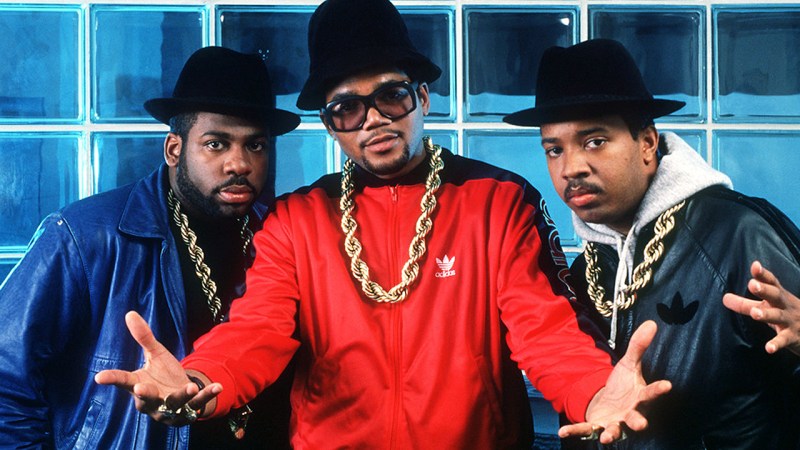
In 1986, Run-DMC Adidas history was made when three MCs from Queens traded bars for bread. Run-D.M.C. reshaped the relationship between hip-hop and fashion with their single “My Adidas.” It wasn’t just a song about sneakers. It was the moment that proved hip-hop could move product, and that the culture’s influence had real, quantifiable value.
Before “My Adidas”: Walk This Way and the Crossover Moment
Before Run-D.M.C. dropped “Walk This Way” in 1986, hip-hop was still isolated from the mainstream. “Walk This Way,” a reprise of the 1975 Aerosmith single, was the first track to bridge the gap between hip-hop and rock.
The single landed hip-hop’s first top 5 spot on the Billboard Hot 100. It would later be called one of the genre’s landmark collaborations. The hit catapulted the crew into millions of unlikely new homes. “[Expletive] in the front row started looking like the Ramones and Cyndi Lauper…” says DMC.
But it was another single from that same year that broke similar barriers outside of music. That track was the 1986 cult classic “My Adidas.” Although somewhat slow to bubble, it eventually proved its value in ways nobody anticipated.
The Run-DMC Adidas Story: Birth of Hip-Hop Brand Endorsements
More Than Just Kicks
“My Adidas” added nuance to hip-hop’s style sensibility and sneaker culture. It was less about rapping about flashy gear. It was about why they rocked it and what it meant to “the culture.”
At the time, hip-hop was full of raw energy and youth. Together, Run-D.M.C., LL Cool J, The Beastie Boys, and Public Enemy signified the advent of the new school of hip-hop music. They were “three brothers, wearing three stripes,” and they looked and dressed like the fans they were rapping to.
In Their Own Words
Here’s what the group had to say about the origin of “My Adidas”:
There was a doctor in our neighborhood named Dr. Deas, and he was like this community activist dude. He even wrote a little pamphlet and he put it around the neighborhood called Felon Shoes, where he was saying that kids and youth in the streets that wore Lee jeans and Kangol hats and gold chains and PUMAs and Adidas without shoe laces were the thugs, the drug dealers and the lowlifes of the community.
So, when we heard that, we were like, “How in the world is he gonna judge a book by its cover?” So, we said, “Let’s do a record about our sneakers; let’s talk about the sneakers that we wear on our feet. Let’s put a positive spin on it to throw it in the face of this Dr. Deas, who’s trying to judge the youth just by appearances.”
Like, you can’t judge a book by its cover. We’re young; we’re educated. A lot of us go to school; a lot of us have jobs. A lot of us look like our peers in the neighborhood, but you can’t judge everybody by that.
So, we wrote the record “Adidas,” and we just wanted to say, because we had a chance to create hip-hop and travel around the world and do good things with hip-hop, that’s why we said, “My Adidas walked through concert doors, roamed all over coliseum floors, stepped on stage at Live Aid.” … How you gonna look at us, not knowing? … Don’t you know I just stepped on stage at Live Aid? The people gave and the poor got paid.
Darryl McDaniels (DMC)
The Résumé Nobody Could Ignore
It wasn’t like Run-D.M.C. hadn’t accomplished anything. They were the first hip-hop group to earn a gold album (Run-D.M.C., 1984). They were the first to be nominated for a Grammy. They earned the genre’s first platinum record (King of Rock, 1985) and first multiplatinum certification (Raising Hell, 1986). They were the first to have videos on MTV. They were also the first to appear on American Bandstand and the cover of Rolling Stone.
The gaudy jewelry, the sweatsuits, the dope kicks were just part of who they were.
The $1.6 Million Deal That Changed Hip-Hop Fashion Forever
40,000 Sneakers in the Air
Then came the moment that changed everything. Angelo Anastasio, a senior Adidas employee, attended Run-D.M.C.’s ’86 Raising Hell tour at Madison Square Garden. There, over 40,000 fans went bananas as the group urged them to “show us your Adidas!” Anastasio rushed back to Adidas headquarters to share what he’d seen.
In the years that followed, the three guys from Hollis, Queens kicked down the doors of the business world. In doing so, they signified a new, more lucrative relationship between music and the brands artists were already freely endorsing.
Eventually, the news of that crowd reception led to Run-D.M.C. inking hip-hop’s first million-dollar endorsement deal. $1.6 million to be exact. It was also hip-hop’s first seven-figure sneaker contract.
The Run-DMC Adidas Superstar Goes Global
Soon after, Run-D.M.C. became poster children for Adidas. The Superstar shell toe sneaker would be to rap culture what the mullet was to rock. The crew took the kicks off the basketball court and onto the blacktops of New York. The shell toe was as much a part of their image as the dookie gold chains.
Over time, the shell toe became arguably one of the most recognizable sneakers in popular culture. Adidas released the shoe in a Run-D.M.C. edition, sans laces.
“My Adidas” set out to set hip-hop detractors straight. But it became more of an anthem for ’80s sneakerheads and hip-hop historians alike.
The Legacy: From Shell Toes to Billion-Dollar Brand Deals
By 1987 and the Together Forever tour, the Run-DMC Adidas partnership had proven to be a match made in heaven. The skyrocketing success of the shell toe set the template for every brand deal that followed.
That template led to deals with Kanye West, Pharrell Williams, Missy Elliott, Snoop Dogg, Ciara, and countless other artists. The Yeezy-Adidas partnership alone generated $2 billion in annual revenue at its peak. That number traces its DNA directly back to three guys in shell toes.
Hip-hop, streetwear, and the brands married to the culture all owe their lucrative relationships to the Run-DMC Adidas blueprint. What started as a song about sneakers became the blueprint for a multi-billion-dollar sneaker economy.
Frequently Asked Questions
Run-D.M.C. signed a deal with Adidas reportedly worth $1.6 million in 1986, making it hip-hop’s first million-dollar endorsement deal and the genre’s first seven-figure sneaker contract. The deal came after Adidas executive Angelo Anastasio witnessed over 40,000 fans hold up their Adidas sneakers at a Run-D.M.C. concert during the Raising Hell tour at <a href=”https://www.msg.com/madison-square-garden” target=”_blank” rel=”noreferrer noopener”>Madison Square Garden</a>.
Run-D.M.C. wrote ‘My Adidas’ in response to a neighborhood activist named Dr. Deas who published a pamphlet associating sneakers, gold chains, and hip-hop fashion with criminality. The group wanted to push back against the stereotype that how you dressed determined your character, using the song to show that the same sneakers worn by supposed ‘lowlifes’ were also worn by artists who had performed at Live Aid and appeared on the cover of Rolling Stone.
Run-D.M.C.’s 1986 Adidas endorsement deal established the template for every hip-hop sneaker partnership that followed. Before their deal, no athletic brand had signed a hip-hop act to an endorsement contract. The deal proved that hip-hop artists could sell products the way athletes could, creating a direct link between cultural influence and commercial power. This template eventually led to billion-dollar partnerships like Kanye West’s Yeezy line with Adidas and Travis Scott’s collaborations with Nike.